
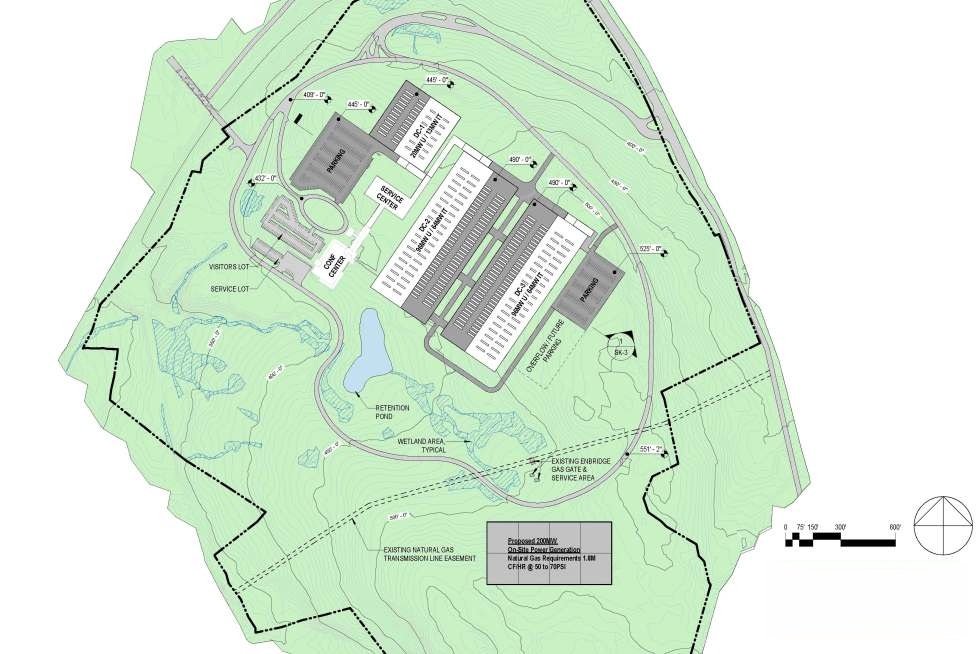
Preliminary approval site plan indicates major site components of the campus redevelopment.
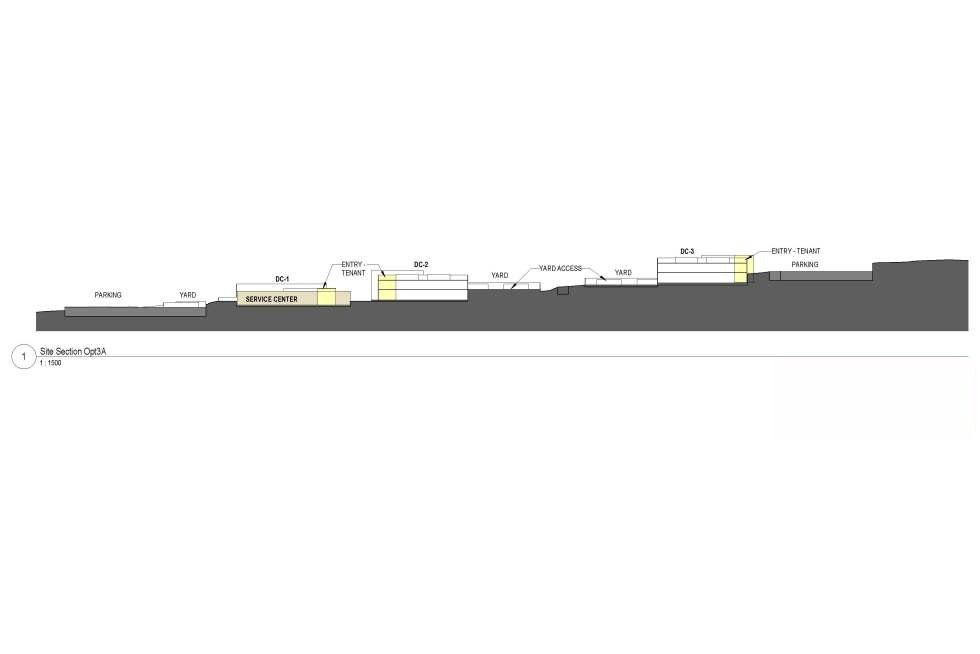
Section through sloping site
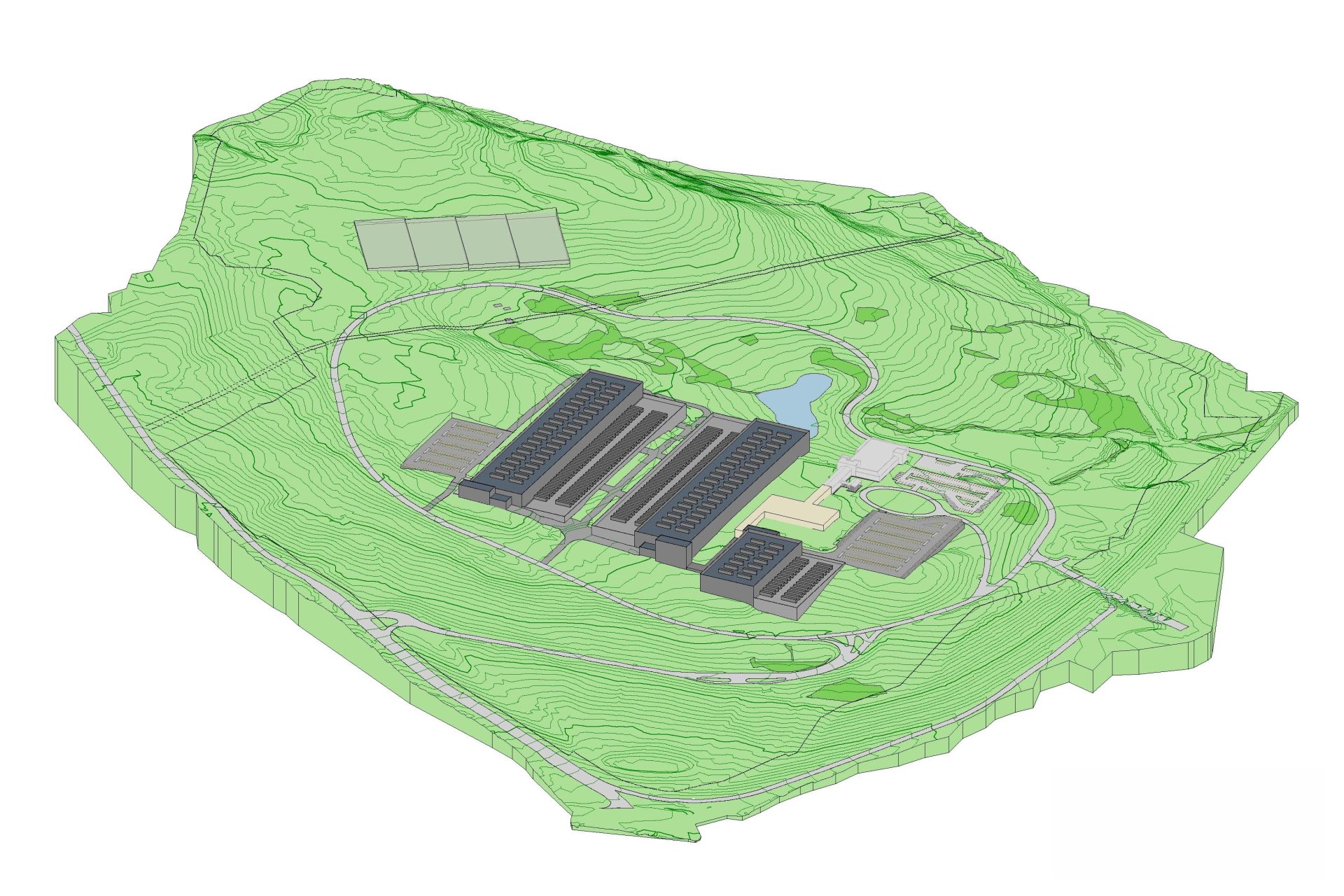
200MW Dat Center Campus Redevelopment Southeast Site Axonometric
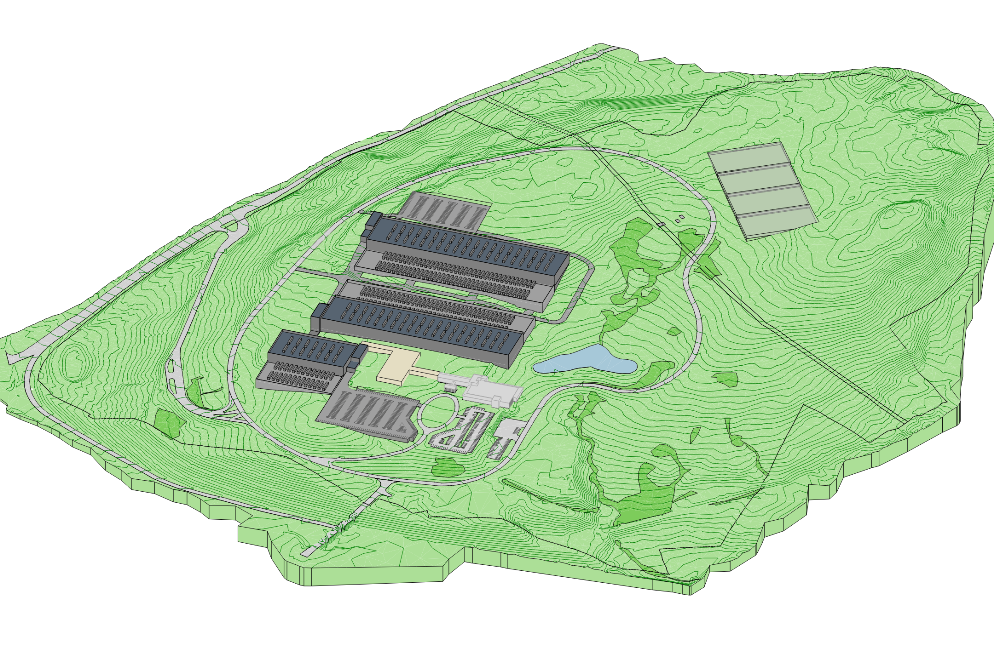
200MW Dat Center Campus Redevelopment Northwest Site Axonometric.
Hyperscale Campus Redevelopment Redefines Energy, Water, and Environmental Stewardship
Client: Confidential
Summary: SIGMA7 collaborated with a confidential client to pursue something radically different: the development and transformation of a 200‑acre former corporate campus into a next‑generation hyperscale environment designed from the ground up for sustainability, resilience, and long‑term independence. Hyperscale data centers - once celebrated as engines of innovation, in the current environment are facing scrutiny over the explosive growth of digital infrastructure, grid strain, water consumption, emissions, and land impacts.
SIGMA7 collaborated with a confidential client to pursue something radically different: the development and transformation of a 200‑acre former corporate campus into a next‑generation hyperscale environment designed from the ground up for sustainability, resilience, and long‑term independence. Hyperscale data centers - once celebrated as engines of innovation, in the current environment are facing scrutiny over the explosive growth of digital infrastructure, grid strain, water consumption, emissions, and land impacts.
The project began with a bold mandate: “create a self-sufficient, environmentally responsible hyperscale data center campus capable of supporting large-scale digital infrastructure without requiring significant new grid generation capacity or water-intensive cooling systems…”
This vision set the tone for a redevelopment strategy that challenged conventional assumptions about what hyperscale infrastructure can be - and what it should be.
A Site with Natural Advantages and Untapped Potential
Nestled on a wooded hillside, the former corporate campus offered a rare blend of existing infrastructure and environmental assets. Mature forests provided natural acoustic buffering. Roadways, stormwater systems, adaptable buildings, and on‑site wastewater capabilities reduced the need for disruptive new construction. Wetlands and protected areas added ecological richness that demanded thoughtful stewardship.
But the site’s most transformative feature lay underground: two high‑pressure interstate natural gas transmission pipelines crossing the property. Early coordination confirmed that these lines could directly fuel an on‑site power generation facility—unlocking the possibility of a campus that could operate independently of regional electrical constraints.
This discovery became the foundation of an energy strategy unlike anything typical hyperscale developments pursue today.
Designed for Community Confidence and Environmental Leadership
Public concerns around data center development are real—and growing. Communities worry about grid reliability, water usage, emissions, noise, and land impact. Rather than reacting defensively, the project team proactively assembled specialists across data center engineering, utilities, environmental science, civil and mechanical systems, and advanced energy technologies. Their mission: address every concern directly and transparently.
Three pillars shaped the sustainability strategy:
1. Water Conservation Without Compromise
Traditional evaporative cooling systems can consume millions of gallons of water annually. To eliminate this dependency, the campus uses high‑efficiency air‑cooled chillers, which require no municipal water, no cooling towers, and no chemical treatment systems. This drought‑resilient approach “effectively decouples the campus redevelopment and growth from local water infrastructure demands.”
2. Noise Mitigation Through Natural and Engineered Design
The site’s natural topography and forest buffers were integrated into the acoustic strategy, supplemented by earth berms, equipment yard screening, strategic building orientation, and engineered sound attenuation systems. The result is a campus "designed to operate quietly - even at hyperscale."
3. Energy Independence Through Advanced Generation Technologies
Energy was the project’s most consequential design decision. Multiple technologies were evaluated and ultimately ruled out:
- Utility grid expansion - too slow and too constrained.
- Gas turbines - efficient but incompatible with procurement timelines.
- Reciprocating engines - faster to deploy but unable to meet emissions requirements.
The breakthrough came with utility‑scale fuel cells, which generate electricity electrochemically rather than through combustion. Their advantages—ultra‑low emissions, minimal noise, high efficiency, modular scalability, and continuous baseload operation—made them ideal for mission‑critical digital infrastructure.
A Fully Integrated, Resilient Microgrid
The campus power strategy combines:
- 200 MW of natural‑gas‑fueled fuel cell generation
- Utility‑scale Battery Energy Storage Systems (BESS)
- Distributed solar photovoltaic generation
- Intelligent microgrid controls and campus‑wide load management
Solar canopies over parking areas generate renewable power while reducing heat‑island effects. BESS installations support load balancing, frequency regulation, and ride‑through capability. Together, these systems form a microgrid capable of operating independently from regional utilities—ensuring resilience, reliability, and long‑term scalability.
"This design fully decouples the campus from the public electrical infrastructure, including future growth."
Hyperscale Infrastructure Built for AI, Cloud, and High‑Density Workloads
The campus features multiple two‑story hardened data center facilities, each approximately 200 ft × 720 ft with 140,000 GSF per floor. Buildings are steel‑framed with insulated precast envelopes and secure 150‑ft‑deep equipment yards housing redundant UPS and emergency generation systems.
Each facility supports:
- 96 MW incoming power / 64 MW critical UPS load
- Baseline rack densities of ~16 kW, scalable to 50+ kW per rack for GPU‑intensive AI workloads
- Tier III Concurrent Maintainable Infrastructure
Cooling strategies include glycol‑fed CRACs, underfloor air distribution, hot/cold aisle containment, and optional liquid‑cooling technologies such as CDUs, rear‑door heat exchangers, direct‑to‑chip, and direct‑to‑plate cooling. This flexible architecture allows tenants to deploy everything from enterprise workloads to advanced AI clusters.
A Blueprint for the Future of Hyperscale Development
This Data Center Campus Redevelopment Project demonstrates how large-scale and hyperscale digital campus infrastructure can be responsibly designed and constructed using an integrated approach that prioritizes energy independence, proactive water conservation and environmental stewardship, without compromising long-term operational resiliency. By combining fuel cell generation, renewable energy, battery storage, and air cooled zero‑water cooling, the project establishes a model for large‑scale digital infrastructure that minimizes environmental impact while maximizing long-term operational independence.
This project establishes a clear model for next generation data center development facing increasing utility and environmental constraints, while addressing community concerns. It is a vision of what hyperscale development can become: a catalyst for innovation that respects natural resources, addressing community concerns while strengthens community confidence, and delivers mission‑critical performance without compromise.


